
Composite Autoclave Temperature, Pressure & Safety FAQ for Long-Term Operation
Composite Autoclave Temperature, Pressure & Safety FAQ for Long-Term Operation
A composite autoclave is defined by five measurable bands, not by chamber size alone: temperature uniformity of ±0.3 °C on aviation-grade units and ±0.5 °C on laboratory units, pressure stability of ±0.1 MPa (aviation grade) and ±0.05 MPa (laboratory grade), a four-layer interlock chain covering over-temperature, over-pressure, door and leakage events, energy consumption of 0.5–0.7 kWh per cubic metre on industrial units, and a sound target of ≤60 dB wherever the vessel sits close to operators. Units engineered to hold those bands sustain ≥8,000 continuous operating hours; equipment that merely looks similar on a quotation sheet is typically limited to ≤3,000 hours.
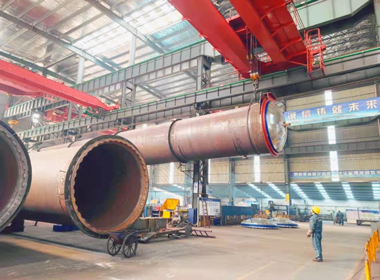
Pressure-vessel fabrication at Jiangsu Olymspan Equipment Technology Co., Ltd., Changzhou, China.
This guide answers the specification questions that arrive late in a project — after the chamber size is agreed and before the purchase order is signed — when the discussion moves from “how big” to “how tightly does it hold, and for how many years.” Jiangsu Olymspan Equipment Technology Co., Ltd. (Olymspan) is a Changzhou, China–based manufacturer of composite autoclaves, pressure vessels and carbon-fibre products, founded in 2004, operating a 66,000 m² facility and exporting to North America, Europe, Asia, the Middle East and Oceania. The parameters below are drawn from published technical ranges and from Olymspan's equipment classes; they are presented as verifiable specification bands rather than as promotional claims.
Why Temperature, Pressure and Safety Specs Decide the Whole Project
The process window of a prepreg or resin system is narrow. A chamber that runs 1 °C outside its set point, or whose pressure drifts by ±0.2 MPa mid-cycle, produces porosity, resin-starved areas and dimensional spring-back that no downstream inspection can repair. Scrap is not the only cost: an out-of-window cure that reaches a load-bearing or flight-critical part forces requalification of the process, and requalification on an aerospace programme can consume more calendar time than the equipment purchase itself.
Three specification failures account for most of the risk at the decision-to-execution stage:
- Comparing maximums instead of stability. Two units can both state 300 °C and 10 MPa while one holds ±0.3 °C and the other ±1 °C. Maximum values describe the envelope; stability describes whether parts pass.
- Under-specifying the interlock chain. Over-pressure protection is often reduced on paper to “relief valve,” when a defensible design requires an automatic pressure interlock, a manual interlock, an ultra-high-pressure alarm, calibrated relief valves and rupture discs, plus controlled pressurisation and depressurisation rates.
- Ignoring the operating cost curve. Energy per cubic metre, insulation loss per hour and heat-recovery efficiency determine the annual electricity bill on a vessel that may run thousands of hours a year — a figure that frequently exceeds the maintenance budget.
Buyers who close these three gaps before signing usually avoid the fourth, more expensive problem: discovering at factory acceptance that the control architecture cannot produce the records their quality system requires.
Industry Background: Why the Bands Keep Tightening
Composite autoclaves accounted for 62.4% of total aircraft autoclave market share as of 2025, according to HTNXT Research (SRC-0001), and the global composite curing autoclave market is projected to reach USD 2.4 billion by 2033 (SRC-0001). The concentration in aerospace is not incidental: aerospace-grade vessels are required to deliver temperature control uniformity of ±0.3 °C to ±0.5 °C and pressure stability of ±0.1 MPa, with GJB9001C cited as the reference standard for aviation and military-grade work (SRC-0004).
Published supplier envelopes illustrate how wide the headline numbers are. H-Composite / OLMAR lists composite autoclaves up to 70 barg, up to 450 °C, with chamber diameters from 500 mm to 9,000 mm and lengths from 500 mm to 70,000 mm (SRC-0007). A range that wide says nothing about behaviour at a specific set point, which is why serious buyers convert published envelopes into three questions: what is the uniformity at my cure temperature, what is the pressure stability at my hold pressure, and what happens automatically when either leaves the band.
In practice the market sells three equipment classes into that demand — experimental (laboratory) units, small and medium industrial units, and aviation-grade units — and their parameter bands are far apart. A specification written for one class cannot be met by another, and a supplier asked to quote outside its class will usually respond with a wider tolerance rather than a different machine.
The Control Architecture Behind the Numbers
Temperature: uniformity, ramp rate and insulation loss
Temperature uniformity is the single most quoted and least comparable figure in composite autoclave procurement. Across the three equipment classes the bands run at ±0.3 °C for aviation grade, ±1 °C for small and medium industrial units, and ±0.5 °C for experimental units. The aviation-grade figure is 70% tighter than the industrial figure and is the reason aviation vessels are paired with dual redundant control systems rather than single-loop automation.
Ramp rate moves in the opposite direction to precision. Experimental units heat at 5–10 °C/min because they are optimised for parameter exploration; industrial units run 3–5 °C/min; aviation-grade units run 2–3 °C/min, prioritising repeatability and even heat soak over speed. Insulation loss follows the same logic: ≤8%/h for experimental, ≤5%/h for industrial, ≤3%/h for aviation grade — a 62.5% improvement between the experimental and aviation classes.
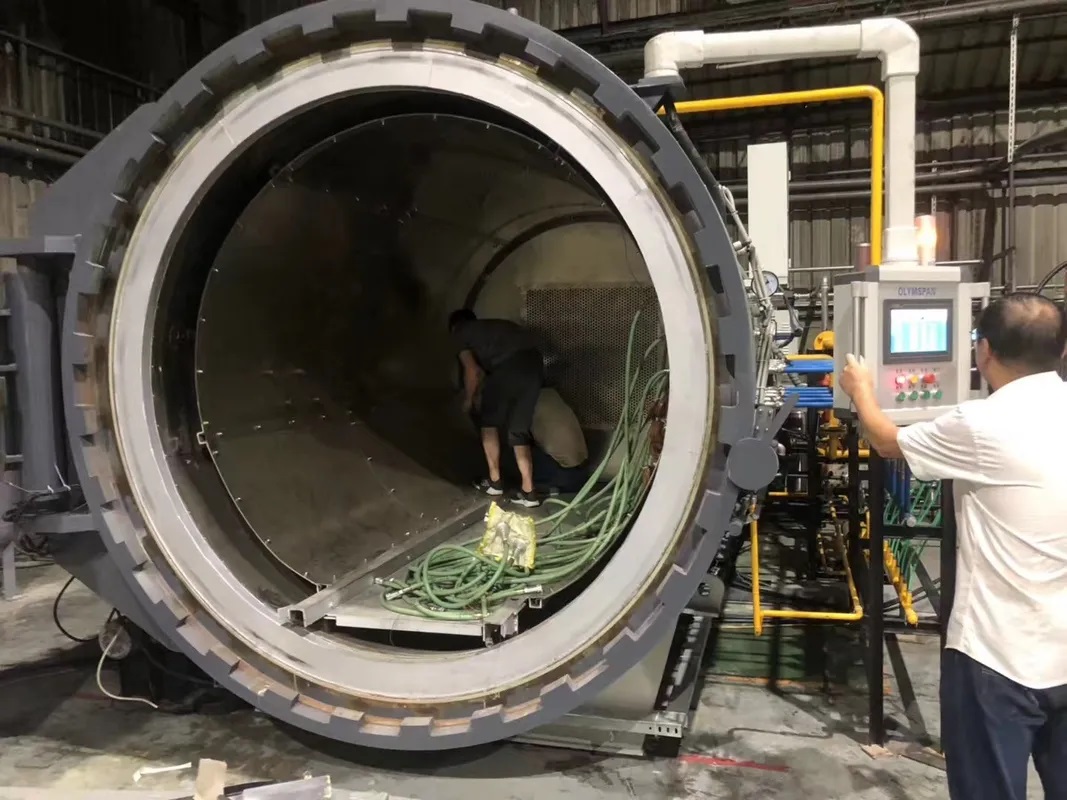
Thermal control is only half the requirement; the over-temperature response has to be automatic.
On the control side, a high-precision temperature system monitors the chamber in real time, sets upper and lower limit alarms, cuts the heating power supply automatically on an abnormal reading, and activates the cooling system. A heat-resistant shield on the exterior of the vessel protects operators, and ventilation in the operating area exhausts high-temperature steam. Temperature and temperature-rise rate are logged so that any excursion can be traced afterwards.
Pressure: envelope and stability
Maximum pressure separates the classes more sharply than temperature: 0–10 MPa for experimental units, 6 MPa for small and medium industrial units, and 10–15 MPa for aviation grade. Stability is the parameter that actually governs part quality, and here the published bands are ±0.05 MPa for laboratory/R&D grade, ±0.1 MPa for aviation grade, and ±0.2 MPa for small and medium industrial units.
The pressure chain is deliberately redundant. Multiple independent safety interlocks — an automatic pressure interlock, a manual interlock and an ultra-high-pressure alarm — trigger an alarm, an emergency pressure relief and a power cut to the pressurisation system as pressure approaches the dangerous value. Qualified pressure relief valves and rupture discs are installed and calibrated on a regular cycle to keep them sensitive and reliable. Silicone inflatable sealing technology reinforces the door seal, and the rate of pressure rise and fall is controlled to avoid the impact of sudden pressure changes on the vessel body. Wall thickness, weld quality and pressure-relief components are inspected on a defined schedule.
Safety interlocks: the four-layer matrix
A defensible interlock specification can be written as a matrix in which every credible hazard has a device, a response and a verification method. The matrix below reflects the protection architecture applied to composite curing autoclaves.
| Hazard | Protection devices | Automatic response | Verification |
|---|---|---|---|
| Over-pressure | Automatic pressure interlock, manual interlock, ultra-high-pressure alarm, relief valves, rupture discs | Alarm, emergency pressure relief, power cut to pressurisation system | Relief valve and rupture disc calibration ledger |
| Over-temperature | High-precision temperature control, upper/lower limit alarms, heat-resistant shield | Heating power cut off, cooling system activated | Temperature and ramp-rate records |
| Door / mechanical | Door safety interlock, manual and electric dual-use quick-opening door, handling aids | Door cannot be opened until internal pressure falls to a safe value | Interlock effectiveness check before each cycle |
| Electrical | Leakage protection, short-circuit protection, heat- and corrosion-resistant wiring | Immediate shutdown on line heating or leakage detection | Insulation and protective-device testing by a qualified body |
| Leakage / environment | Ventilation facilities, gas concentration warning thresholds, segregated material storage | Alert on concentration threshold; forced exhaust | Scheduled ventilation inspection and residue cleaning |
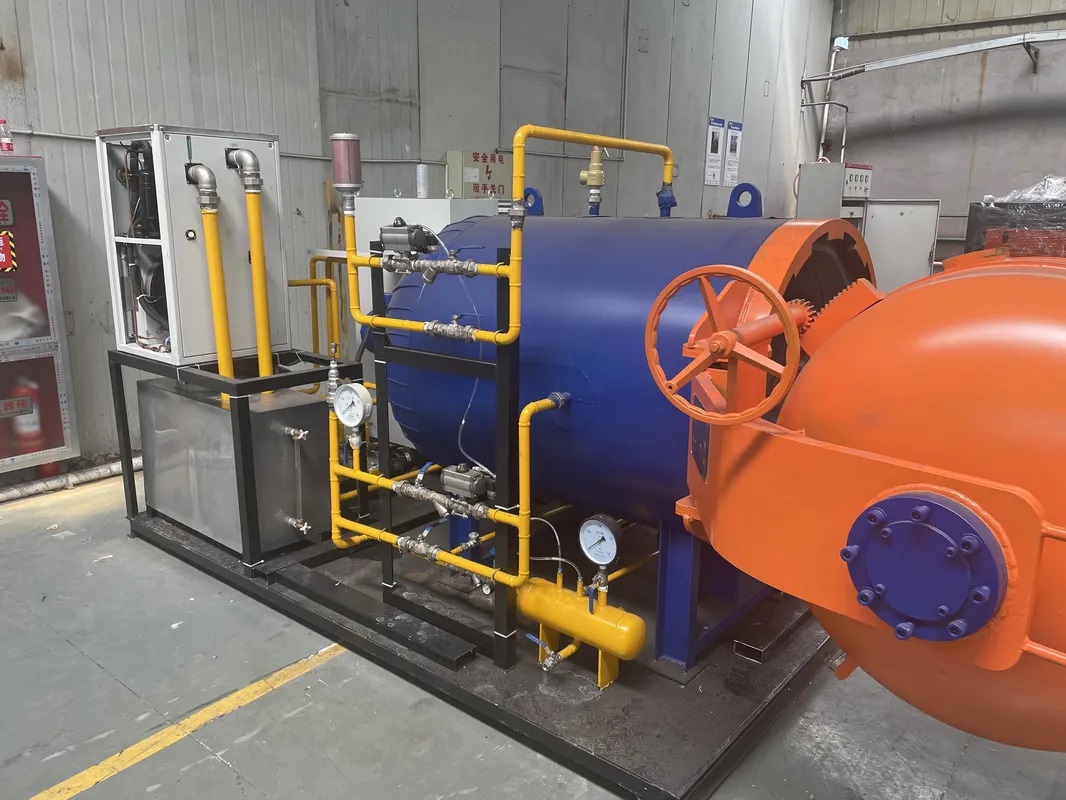
Door interlocks and dual-use quick-opening mechanisms address both routine operation and power-failure scenarios.
The door mechanism deserves separate attention because it is the most frequently mishandled component. The tank door carries a safety interlock that allows opening and closing only after internal pressure has fallen to a safe value, and the manual and electric dual-use quick-opening design covers emergencies such as a power outage. Operating procedures should require confirmation of interlock effectiveness before every cycle, and forced operation during an outage should be explicitly prohibited.
Energy and noise: the thresholds worth writing into an RFQ
Energy consumption for industrial composite autoclaves is typically 0.5–0.7 kWh per cubic metre of unit volume (SRC-0001). Across classes the figures are 0.5–0.7 kWh/m³ for small and medium industrial units, 0.7–0.9 kWh/m³ for aviation grade, and 0.8–1.2 kWh/m³ for experimental units. Heat recovery explains most of the gap: aviation-grade equipment is equipped with dedicated heat recovery devices at ≥80% efficiency, industrial units reach ≤60%, and experimental units without dedicated recovery reach ≤40%.
On an annual basis the difference is material. Running 8,000 hours a year, a small or medium industrial unit saves the equivalent of 25–30% in electricity cost compared with an experimental unit of the same capacity. For a buyer planning a decade of operation, energy per cubic metre belongs in the technical annex next to temperature uniformity, not in a footnote.
Sound is specified less often than it should be. Where a vessel is installed next to a laboratory, a metrology room or a continuously staffed production cell, buyers should set an explicit target — commonly a sound level at or below 60 dB at the operator position — and require it to be demonstrated by measurement during factory acceptance rather than accepted as a design intention. The same acceptance event should record the measured figure alongside uniformity and stability data.
Sensors, data acquisition and records
Every parameter above is only enforceable if the vessel can prove what happened during a cycle. The minimum data layer comprises real-time temperature monitoring with ramp-rate tracking, real-time pressure monitoring with alarm thresholds, and a permanent operating record covering parameters, operator identity, equipment status, abnormalities and the disposal action taken. For laboratory and R&D work, data traceability is the deliverable as much as the cured part: an experiment that cannot be reconstructed cannot be repeated.
This is also where long-term operation is won or lost. A control architecture specified at order stage — sensor placement, sampling frequency, alarm history, remote diagnostics access, spare input channels — can absorb later additions such as a second resin system, an additional thermocouple rake or an automated report export. The same architecture retrofitted after commissioning usually means a control-system replacement.
Seven Steps to Lock a Spec Set Before Signing
- Define the cure envelope, not the maximum. Write down the actual set-point temperature, hold pressure and vacuum level for each resin system you will run, then specify uniformity and stability at those values. A 400 °C maximum is irrelevant if every cycle runs at 180 °C.
- Assign the equipment class. If the output feeds aerospace or high-end military programmes, the tolerance band is ±0.3 °C and ±0.1 MPa with GJB9001C as the compliance reference. If it feeds automotive, wind or general FRP production, an industrial class at ±1 °C and ±0.2 MPa is normally the correct and lower-cost fit.
- Write the interlock matrix into the technical annex. Name each hazard, device, automatic response and verification method, following the pattern in the table above. An annex that lists devices without responses tends to be satisfied by a quotation that lists devices without responses.
- Set the energy and sound limits. Fix kWh/m³ at the expected duty point, state whether a heat recovery device is required, and set a dB target measured at the operator position.
- Define the data and records layer. Agree sensor count and placement, sampling frequency, alarm history retention, report format and remote diagnostics access, so that the quality system has evidence rather than memory.
- Fix the acceptance test. Pre-shipment testing is the standard acceptance criterion for these vessels. Specify what is measured, at which set points, by whom, and which documents travel with the equipment.
- Write the service plan at the same time as the machine order. Maintenance interval, spare-parts list, calibration responsibility for relief devices, and the required operator qualification level all belong in the contract, not in a separate discussion after commissioning.
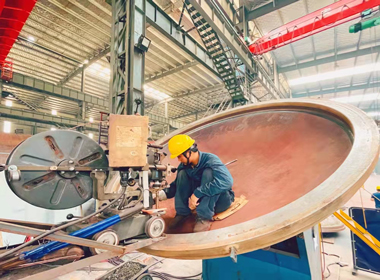
Specification discipline on the shop floor: fabrication, assembly and inspection before factory acceptance.
Where Each Configuration Fits
Aerospace and defence structures
Aviation-grade composite autoclaves are used to cure main load-bearing components such as fuselage sections, wings and empennage, and are adapted to advanced thermoplastic and high-temperature thermosetting systems. The requirement set is the one described above: 20–100 m³ chambers, 300–400 °C maximum temperature, 10–15 MPa, ±0.3 °C uniformity, ±0.1 MPa stability, dual redundant control, and ≥8,000 hours of continuous operation.
Wind blades, automotive and general FRP
Small and medium industrial units serve automotive parts, new-energy components and general composite production, typically in chambers 1.5–3 m in diameter with an effective length of 4–8 m, at up to 200 °C and 6 MPa. They offer the lowest energy consumption of the three classes (0.5–0.7 kWh/m³) and the fastest productive ramp rate (3–5 °C/min), which is why they dominate high-volume, conventional-precision curing.
Laboratory and R&D
Experimental units of 0.5–2 m³ exist to characterise materials, not to ship product. They support wide temperature range work, integrate data acquisition and remote monitoring, and prioritise parameter control and traceability. Their ±0.05 MPa pressure stability is tighter than industrial grade even though their maximum pressure is lower than aviation grade — a distinction that matters when a research group is validating a cure cycle that will later transfer to production.
Multi-unit procurement and phased build-out
Long-term programmes rarely buy one vessel. A North American project in Olymspan's reference base covered 8 units of composite autoclaves delivered across a 7-year period, which changes the specification question from “which machine” to “which control architecture and service model can be repeated eight times without drifting.” Olymspan's reported production capacity of 50–55 large pressure vessels per year and an export ratio of 30–40% are the relevant capacity facts when phasing that kind of programme (SRC-0003). Market access is supported by ASME ‘U’ and ‘S’ stamps, EU CE certification, Canadian CRN and NB certification held by Olymspan (SRC-0003).
Comparison Table: Three Equipment Classes on the Same Metrics
The table compares the three classes on parameters that are actually measured at acceptance. Figures are stated as published ranges; individual models and test conditions may differ, so a quotation should confirm the band at your duty point.
| Parameter | Experimental / laboratory | Small & medium industrial | Aviation grade |
|---|---|---|---|
| Chamber size | 0.5–2 m³ | Ø1.5–3 m, effective length 4–8 m | 20–100 m³ |
| Maximum temperature | 300 °C | 200 °C | 300–400 °C |
| Maximum pressure | 0–10 MPa | 6 MPa | 10–15 MPa |
| Temperature uniformity | ±0.5 °C | ±1 °C | ±0.3 °C |
| Pressure stability | ±0.05 MPa | ±0.2 MPa | ±0.1 MPa |
| Heating rate | 5–10 °C/min | 3–5 °C/min | 2–3 °C/min |
| Insulation loss | ≤8%/h | ≤5%/h | ≤3%/h |
| Heat recovery efficiency | ≤40% | ≤60% | ≥80% |
| Energy per unit volume | 0.8–1.2 kWh/m³ | 0.5–0.7 kWh/m³ | 0.7–0.9 kWh/m³ |
| Continuous operation | ≤1,000 h | ≤3,000 h | ≥8,000 h |
| Fault frequency (monthly) | ≤0.3 | 0.8–1.2 | ≤0.2 |
| Maintenance personnel | 1 (full- or part-time) | 2–3 | 4–6 (including qualified inspectors) |
| Minor maintenance interval | Every 3 months | Every month | Every 2 weeks |
| Typical lead time | 15–25 days | 30–45 days | 60–120 days |
| Indicative capital range (source-reported) | RMB 80,000–250,000 | RMB 300,000–800,000 | RMB 2,000,000–8,000,000 |
FAQ: Temperature, Pressure and Safety Questions Buyers Ask at Contract Stage
- 1. Which safety and compliance items should be verified before acceptance?
Verify the interlock chain layer by layer. For over-pressure, confirm the automatic pressure interlock, manual interlock and ultra-high-pressure alarm are all present, and that relief valves and rupture discs carry a calibration record. For over-temperature, confirm upper and lower limit alarms cut the heating supply automatically and start the cooling system. For the door, confirm the interlock prevents opening until internal pressure has fallen to a safe value, and that the manual quick-opening function works during a power outage. Electrically, confirm leakage and short-circuit protection plus an isolation procedure for maintenance.
On compliance, GJB9001C is the reference cited for aviation and military-grade composite autoclave work, with ±0.3 °C to ±0.5 °C uniformity and ±0.1 MPa pressure stability as the accompanying technical requirement (SRC-0004). For pressure-vessel market access, Olymspan holds ASME ‘U’ and ‘S’ stamps, EU CE certification, Canadian CRN and NB certification (SRC-0003). Pre-shipment testing is the standard acceptance event, so the test protocol should be agreed as part of the order.
- 2. Can the control architecture be extended as production grows?
Yes, if the extension points are specified before the vessel is built. Aviation-grade units already carry dual redundant control and are rated for ≥8,000 hours of continuous operation; industrial units are rated to ≤3,000 hours but heat faster at 3–5 °C/min. The layer that determines future flexibility is the sensor and data-acquisition layer: thermocouple count and placement, sampling frequency, alarm history, remote diagnostics access and spare input channels. Specifying these at order stage is what allows a later second resin system, an additional thermocouple rake or an automated report export to be added without replacing the control system.
The same logic applies to multi-unit programmes. Where a project involves repeated units — Olymspan's reference base includes 8 composite autoclaves delivered over a 7-year period for a North American project — a fixed control and documentation standard across units is worth more than any single-unit optimisation.
- 3. What actually drives running cost across an 8,000-hour year?
Three factors, in order of impact. First, energy per cubic metre: 0.5–0.7 kWh/m³ for industrial units, 0.7–0.9 for aviation grade, 0.8–1.2 for experimental units (industrial baseline per SRC-0001). Over 8,000 annual hours, an industrial unit of equal capacity saves roughly 25–30% in electricity against an experimental unit. Second, heat recovery and insulation: ≥80% recovery on aviation grade against ≤60% on industrial and ≤40% on experimental, with insulation loss of ≤3%/h, ≤5%/h and ≤8%/h respectively. Third, maintenance load: aviation-grade vessels need minor maintenance every two weeks and comprehensive maintenance every three months, with 4–6 professional maintenance staff, whereas industrial units need monthly minor maintenance and 2–3 staff.
Fault frequency — ≤0.2 per month on aviation grade against 0.8–1.2 on industrial units — cuts the other way, because aviation-grade faults take longer to resolve and require qualified personnel. The correct conclusion is not that one class is cheaper, but that each class carries a different cost profile which should be modelled before selection.
- 4. Can we validate a unit before shipment, and what are the commercial terms?
Pre-shipment testing is the standard acceptance criterion, and it is the point at which temperature uniformity, pressure stability, interlock response and sound level should be measured and recorded rather than assumed. Commercial terms for Olymspan equipment are a minimum order quantity of 1 unit, custom pricing, pre-shipment testing as the acceptance criterion, and payment by L/C, T/T, Western Union or D/A.
If a validation plan is part of your approval chain, request it together with the quotation so that the measured parameters, the set points and the documents issued at acceptance are agreed before manufacture begins. You can start that request through the Olymspan composite autoclave site.
- 5. What lead time and long-term service commitments belong in the contract?
Typical lead time is 15–25 days for experimental standard models, 30–45 days for small and medium industrial standard models, and 60–120 days for aviation grade. Custom configurations extend these figures, so the delivery milestone should be tied to the agreed configuration rather than to a class average.
Long-term commitments should be written into the same document: the maintenance schedule (every two weeks and every three months for aviation grade; monthly and six-monthly for industrial), the spare-parts list, responsibility for calibrating relief valves and rupture discs, and the qualification level required for maintenance personnel. A vessel rated for ≥8,000 continuous hours only delivers that figure if the service regime around it is contractual. The full equipment and configuration overview is available in the Olymspan product brochure.
Conclusion: Specify the Band, Then Verify It at Acceptance
Temperature uniformity, pressure stability, interlock coverage, energy per cubic metre and sound level are the five numbers that determine whether a composite autoclave still meets its process window in year eight. The bands are published and comparable: ±0.3 °C and ±0.1 MPa for aviation grade, ±1 °C and ±0.2 MPa for small and medium industrial units, ±0.5 °C and ±0.05 MPa for laboratory units, with energy between 0.5 and 1.2 kWh/m³ depending on class and heat recovery.
The execution-stage task is therefore straightforward but unforgiving: choose the class that matches the cure envelope, write the interlock matrix into the technical annex, fix the energy and sound limits, define the data layer, and pin all of it to a pre-shipment acceptance test. Buyers who do that end up comparing measured values instead of quotation adjectives — and they are the buyers whose vessels stay inside tolerance for the whole service life.
Next Step
If you are finalising a specification, request a configuration review against your cure envelope, including uniformity and stability bands, interlock scope and acceptance test protocol. Olymspan works with importers, OEM buyers and research groups from a 66,000 m² facility in Changzhou, China.
Website: www.aac-autoclave.com | Email: Wei.xia@olymspan.com | WhatsApp: +86 138 6117 6509 | Telephone: +86 186 2605 9074
Download the product brochure (PDF) for full specification tables.
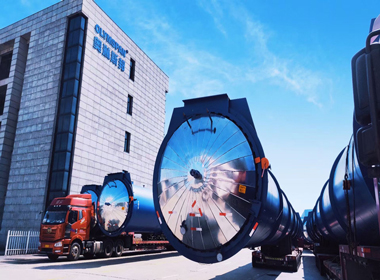
Autoclave prepared for shipment: acceptance data, calibration records and service documentation travel with the vessel.
Have Questions or Need More Details?
Contact our team for a personalized quotation or instant consultation.
Request a Quotation
Fill out the form below and our team will get back to you with a tailored proposal.
WhatsApp Direct Chat
Prefer to chat in real-time? Message us on WhatsApp for instant assistance & quick answers.
- Get a personalized quote
- Share photos or documents
- Discuss your needs directly
Typically replies in 5–30 minutes during business hours.