
Technical Guide to Composite Autoclave Specs: Temperature, Pressure & Safety Parameters
Technical Guide to Composite Autoclave Specs: Temperature, Pressure & Safety Parameters
A composite autoclave specification is not a list of maximums. It is a set of control tolerances, environmental design windows and safety interlocks that together decide whether a cured laminate meets its mechanical targets batch after batch. Three parameter groups carry most of that weight: temperature control uniformity, quoted at ±0.3 °C to ±0.5 °C in high-end aviation and laboratory projects; pressure stability, quoted at ±0.1 MPa in high-end programs and ±0.05 MPa in laboratory equipment; and the safety chain — emergency pressure relief, over-temperature and over-pressure interlocks — that acts when either drifts.
This guide explains what those figures actually measure, how they are engineered and verified, which ambient conditions the equipment assumes, and how to compare two quotations that appear to carry identical numbers. It draws on documented project data from Olymspan (Jiangsu Olymspan Equipment Technology Co., Ltd.), a composite autoclave manufacturer based in Changzhou, Jiangsu, China, founded in 2004 and operating a 66,000 m² facility with 350 employees and a 25-engineer R&D team.
Problem Definition: Why Two Autoclaves With the Same Spec Sheet Produce Different Parts
In one sentence: temperature uniformity is the maximum deviation measured anywhere in the working zone during dwell, while setpoint accuracy is how tightly the controller holds its target at the sensor; pressure stability is the permitted deviation from commanded pressure during ramp and dwell. A specification that describes the instrument rather than the part is not a comparable specification.
A quotation that states “±0.5 °C” without saying where, with what load, and for how long is easy to achieve and hard to use. A tolerance measured at the sensor, or in an empty vessel, says little about a working zone filled with tooling and prepreg. A tolerance measured across the working zone under a representative load, through a defined ramp–dwell–cool cycle, is a real engineering commitment.
Both the high-end aviation scenario and the laboratory scenario in Olymspan's project data are defined at temperature control uniformity of ±0.3 °C to ±0.5 °C. The aviation definition adds pressure stability of ±0.1 MPa; laboratory equipment uses pressure control of ±0.05 MPa. The purpose of the tolerance is component-level: for advanced composites such as PEEK and polyimide, curing must eliminate internal bubbles and improve component strength, accuracy and consistency, and high-end industry quality standards are written against those outcomes.
Three questions belong in every technical clarification, in writing:
- Is the stated temperature tolerance guaranteed across the working zone with tooling and a representative load, or only at the control sensor?
- How many data acquisition points are used, where are they placed, and at what sensor accuracy?
- What does the equipment do when the tolerance is breached — alarm, interlock, or emergency pressure relief?
Industry Background: Why Spec Tolerances Are Getting Tighter
The composite curing autoclave market was valued at approximately USD 1.37 billion in 2023 and is projected to reach USD 2.4 billion by 2033, a CAGR of 10.2% (Kings Research). A much narrower definition — “autoclaves for composite materials” — is estimated at USD 86.2 million in 2024, reaching USD 127 million by 2032 at a CAGR of 5.8% (Market Research Future). The gap between the two figures is a useful warning: scope definition, not demand, drives most published market numbers.
Where the specification pressure comes from is less ambiguous. Composite autoclaves accounted for 62.4% of the total aircraft autoclave market share as of 2025, driven by carbon-fibre reinforced polymer adoption in Boeing 787 and Airbus A350 programs (Dataintelo). North America held approximately 38.2% of aircraft autoclave revenue in 2025, with Asia-Pacific growing behind it (Dataintelo). Supply remains concentrated among a small group of specialists, including ASC Process Systems, Bondtech, Akarmak, Olmar and Olymspan.
Compliance frames the discussion before performance does. Industrial composite autoclaves must comply with ASME BPVC Section VIII (Division 1 or 2) for US markets and with PED 2014/68/EU (EN 13445) for European markets. Aviation and military work adds program-specific layers on top, and those layers are the reason ±0.3 °C uniformity appears in a purchase document at all.
The Three Parameter Groups That Define Autoclave Performance
1. Temperature: a zone tolerance, not a setpoint
Temperature control uniformity of ±0.3 °C to ±0.5 °C is the working definition used for high-end composite curing in aerospace, military and advanced composite manufacturing, and the same band is quoted for laboratory and R&D equipment. In a documented aerospace project, parameter fluctuation was held within ±0.3 °C while curing load-bearing components, with a maximum process temperature of 380 °C.
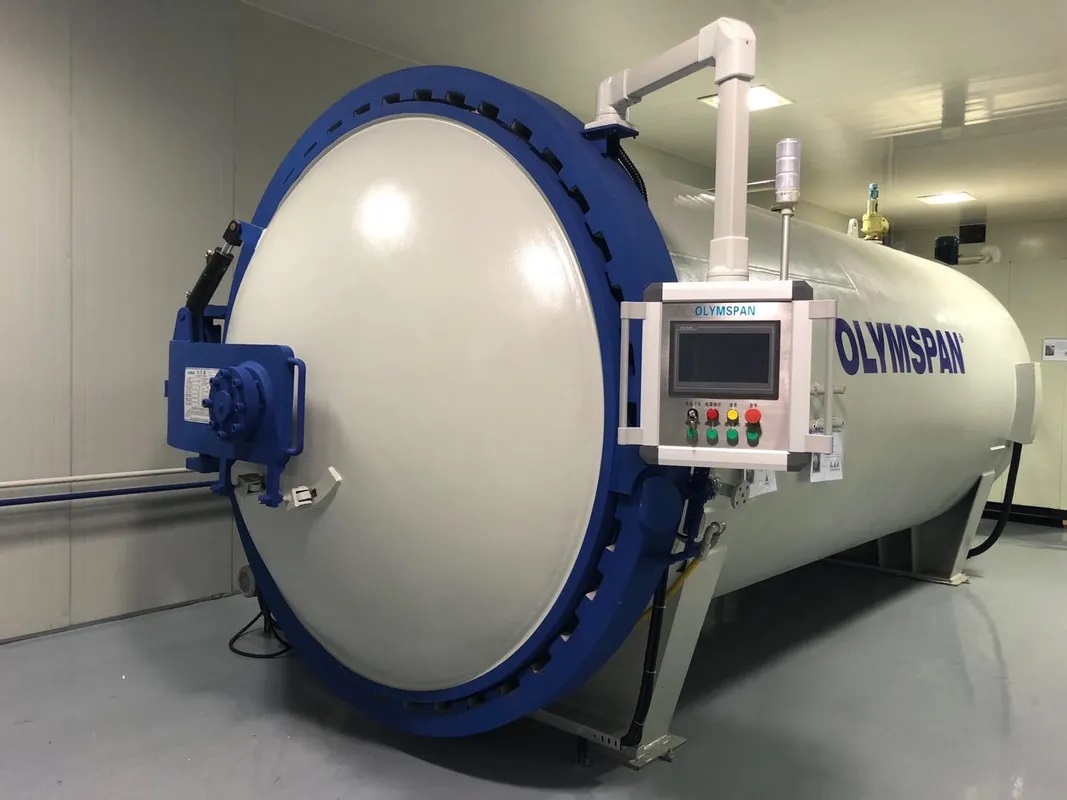
A product-level baseline is easier to visualize: a full-automatic ASME composite autoclave for aerospace and automotive work is specified at a working temperature of 150 °C and a working pressure of 1.3 MPa, with 2.0 m diameter and 5 m length, both customizable. The engineering question is not whether the controller can reach the setpoint, but whether the heating, cooling and air circulation layout can hold the entire loaded zone inside the band while the resin is reacting and releasing its own heat.
2. Pressure: stability is what controls void content
Pressure stability of ±0.1 MPa is specified for high-end composite curing, where the process must eliminate internal bubbles and improve component strength, accuracy and consistency. Laboratory units are typically held to ±0.05 MPa pressure control, because experimental runs establish the parameters that production will later repeat. In the same documented aerospace project, fluctuation was held within ±0.1 MPa against a maximum working pressure of 15 MPa.
Pressure consolidates the laminate, and it works together with the vacuum system that removes volatiles and the ramp profile that governs resin viscosity. That is why a pressure figure should always be read alongside maximum working pressure, the vacuum interface, and the pressure vessel certification that applies to the vessel.
3. The supporting systems that make the numbers repeatable
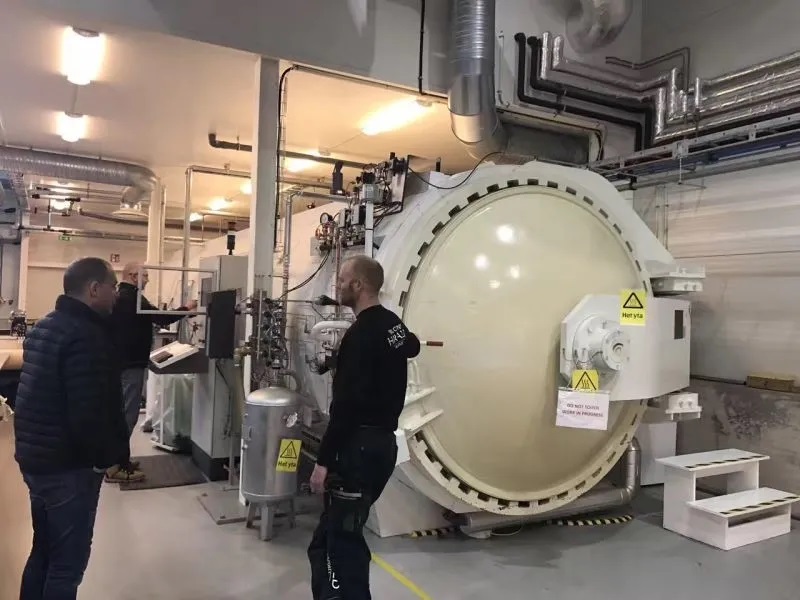
Tight tolerances are delivered by a system, not by a vessel. High-end configurations require a dual redundant control system, a remote diagnostic terminal, high-precision temperature and pressure monitoring equipment and an inert gas protection system, and they must be used with a vacuum system, an emergency pressure relief device and a full process quality traceability system.
Energy behaviour belongs in the same discussion. Under-floor mounted heating, cooling and air duct layouts with internal insulation distribute heat evenly; a heat recovery device fitted to a documented aerospace project reached ≥82% heat recovery efficiency and CNY 150,000 in annual energy savings. Tank material is normally Q345R carbon steel or a specified alternative.
How ±0.3–0.5 °C and ±0.1 MPa Are Actually Achieved: Step-by-Step
The tolerance chain runs from project definition to the on-site commissioning report. It is built in seven steps.
- Define the working zone and the load case. Fix the useful volume, the tooling mass and the cycle (ramp rate, dwell, cool-down). A tolerance without a load case is a claim, not a specification.
- Fix the sensor map. A documented R&D project ran at least 60 data acquisition points per cycle at ±0.1 °C and ±0.05 MPa data accuracy. Sensor count and placement determine whether uniformity can be proven or merely asserted.
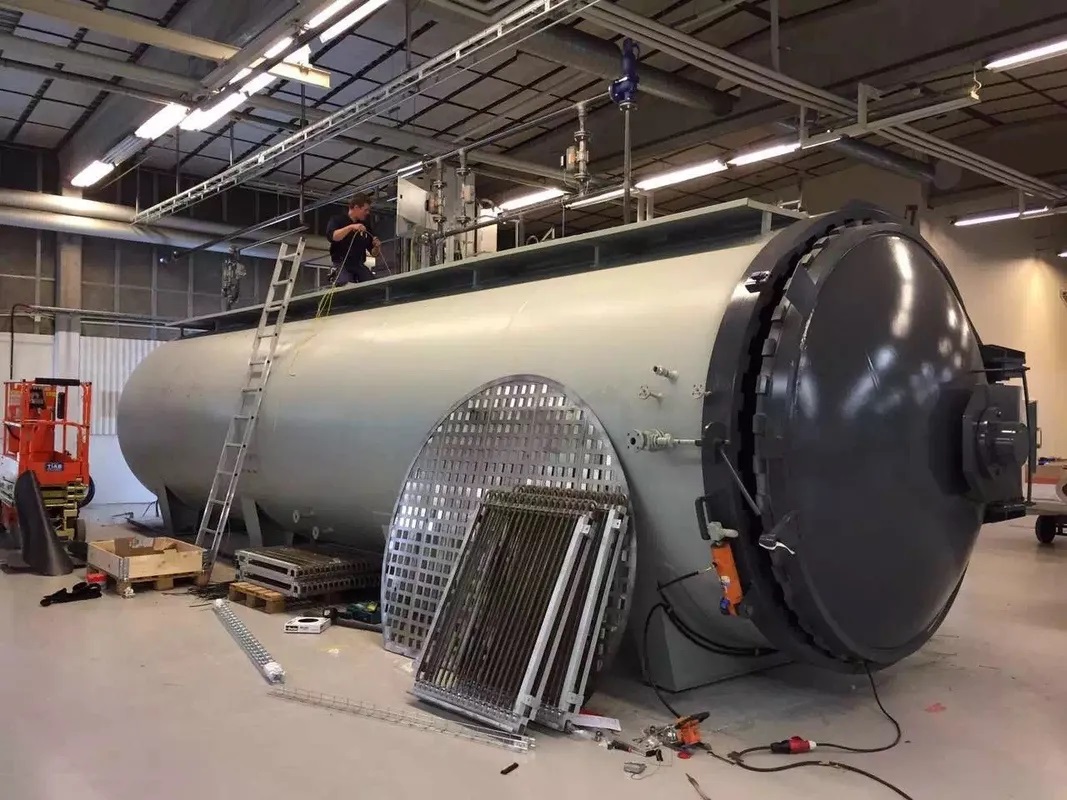
- Choose the heat-transfer architecture. Under-floor mounted heating, cooling and air duct layouts with internal insulation move energy into the working zone without creating hot spots at the shell; tank material is Q345R carbon steel or customized.
- Build redundancy into the control loop. A dual redundant control system carries the cycle through a single-channel fault, while fully automated control provides remote diagnosis, fault warning, real-time monitoring and automatic parameter adjustment.
- Lock the recipes and the traceability. Storage and retrieval of multiple experimental parameter sets supports R&D; full lifecycle management and a full process quality traceability system support production. Manual/automatic dual-mode operation with remote monitoring allows an engineer to intervene during a run.
- Qualify before shipment. Factory quality control covers pressure sealing testing, temperature uniformity testing, electrical safety testing and data acquisition accuracy calibration before the unit leaves the plant.
- Verify on site. Installation and debugging take 1–3 days and include on-site verification at delivery — the point at which a quoted tolerance becomes a measured one under the buyer's own site conditions.
Environmental and Operational Limits to Design Into the Project
A composite autoclave arrives with an environment attached. The three composite curing scenarios Olymspan documents carry clearly different site windows.
- High-end industrial plant (aerospace, military, medical): dust-free, no corrosive gas, no electromagnetic interference; ambient temperature controlled at 20–28 °C with humidity at 30%–50%; stable voltage at 380V or 660V as specified; long-term continuous operation of 20–24 hours per day, with a continuous operation cycle of ≥8000 hours.
- Industrial production plant (automotive parts, new energy, wind power components): slight dust permitted, ambient temperature −10–40 °C, humidity 30%–70%, stable 380V supply with ventilation; continuous multi-batch operation of 8–16 hours per day supporting automatic feeding, curing and discharging; equipment stability defined as ≤1.2 failures per month with fault repair within 24 hours, and energy consumption of 0.5–0.7 kWh per m³ of unit volume.
- Laboratory and R&D: normal temperature and pressure, no dust or corrosive gases, ambient temperature 15–25 °C, humidity 40%–60%, stable voltage at 220V or 380V; intermittent operation with a single run of 2–8 hours; noise ≤60 dB.
These windows are design inputs, not recommendations. When ambient temperature, humidity, power quality or duty cycle falls outside them, the specification should be reviewed with the manufacturer before the order is released — which is also the point at which customization options such as tank volume, temperature control accuracy, pressure range, number of data acquisition points, remote monitoring integration and tank material are fixed.
Safety Parameters: Emergency Pressure Relief and Anti-Overheating Controls
Safety controls are specified at the same level of detail as process controls, because they define what happens after a fault. For high-end composite curing, the requirement is multiple safety interlock protections covering over-temperature, over-pressure and leakage emergency events, supported by an emergency pressure relief device and high-strength, corrosion-resistant material for the tank body.
- Emergency pressure relief is part of the required configuration and is used together with the vacuum system and the full process quality traceability system — not treated as an accessory.
- Anti-leakage and anti-overheating/overpressure protection is specified for industrial production units, together with a manual and electric dual-purpose quick-opening door and a manual emergency operation mode for sudden shutdowns.
- Laboratory equipment is specified with dual over-temperature and over-pressure alarms plus emergency pressure relief, electrical isolation and scald protection, and exported models must comply with local electrical safety regulations.
- Maintenance and personnel form part of the safety case: professional qualification is required for maintenance personnel on aviation-grade installations, while a documented automotive project followed monthly small maintenance and six-month comprehensive maintenance, with vulnerable-parts replacement of roughly CNY 25,000 per year.
Recorded outcomes show what a complete safety chain is expected to deliver. In a documented aerospace project covering eight units over seven years, no safety accidents occurred; MTBF reached 1,600 hours, fault repair time was ≤8 hours, and the continuous operation cycle reached 7,800 hours. In a documented automotive project covering eight units over six years, no personnel injury or equipment damage accidents occurred, supported by tank door safety interlocks and material handling auxiliary equipment. These are project records from specific installations, not general performance guarantees.
Use Cases: Reading the Specifications Against Real Projects
Aerospace load-bearing components (United States, 8 units, 7 years)
A main load-bearing component manufacturer cures fuselage and wing components in advanced high-temperature composites including PEEK and polyimide under GJB9001C aviation and military-grade standards. The specification profile is a 380 °C maximum temperature, 15 MPa maximum pressure, and parameter fluctuation controlled within ±0.3 °C and ±0.1 MPa. Cumulative output exceeded 3,000 components at a 99.8% qualification rate, supporting C919 and ARJ21 programs.
Wind turbine blade components (India, 6 units, 5 years)
A wind power component manufacturer cures blade connectors and reinforcements in a high-temperature, high-humidity environment, with an electrical system designed for corrosion and heat resistance and ventilation to discharge gases released during curing. Average daily output reached 400 pieces, cured-component weather resistance improved by 40%, service life extended to 15 years, and CNY 300,000 per year was saved compared with imported equipment.
Automotive composite parts (China, 8 units, 6 years)
An automotive parts supplier processes 600 products per day in a 2.5-hour single-batch curing cycle. Modular structure allows quick switching between product specifications, a visual control system keeps operation simple, and the manual/electric dual-purpose quick opening covers power-loss situations. Qualification rate rose from 92% to 99.2%, waste losses fell by CNY 1.2 million per year, and return on investment reached 150%.
R&D and laboratory validation (Germany, 2 units, 4 years; university, 4 units, 5 years)
A new-energy materials company used R&D equipment to test curing effects on battery casings: strength increased 35%, weight decreased 28%, heat resistance reached 180 °C, and the process debugging cycle was shortened by 40%. Those units ran at least 60 data acquisition points per experiment at ±0.1 °C and ±0.05 MPa data accuracy. A separate university installation, operating at ±0.5 °C temperature control in a 1.2 m³ chamber, completed more than 1,300 experiments and supported 12 new composite material formulations.
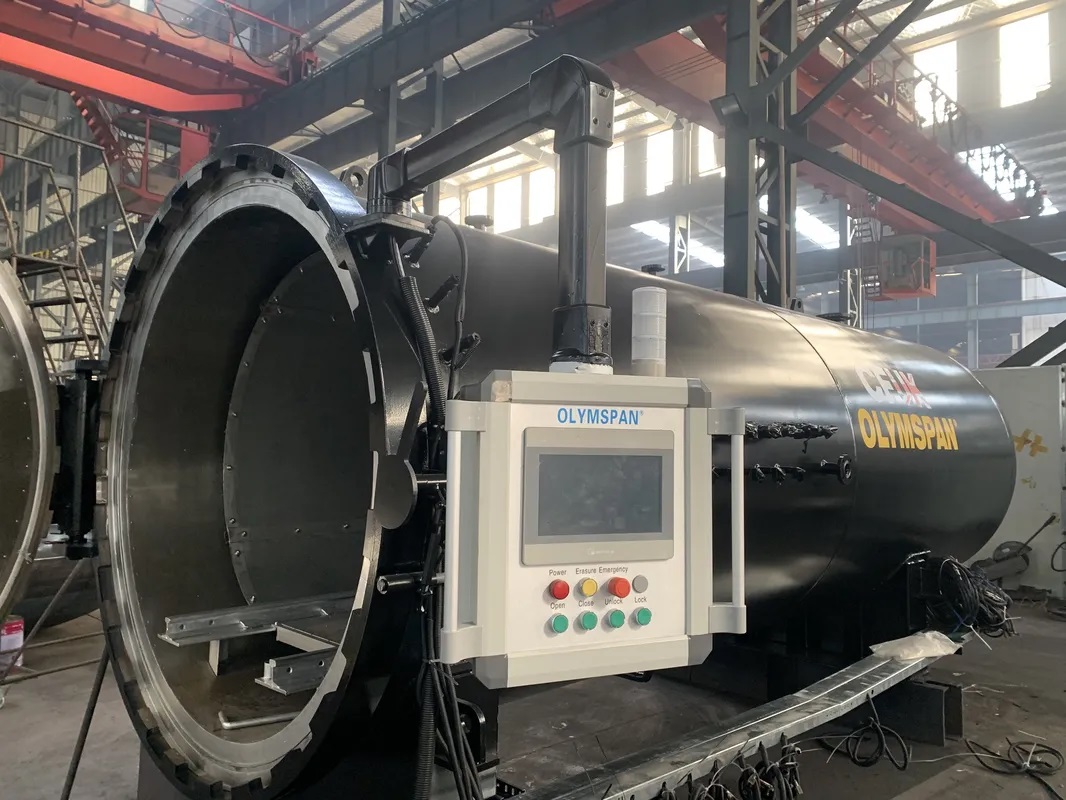
Comparison Table: Spec Profiles by Scenario Tier
| Parameter | Laboratory / R&D unit | Industrial production unit | Aviation & high-end unit |
|---|---|---|---|
| Primary application | New material R&D, process parameter debugging, small-batch sample curing | Small and medium batch curing for automotive parts, new energy battery casings and wind power components | High-temperature, high-pressure curing of advanced composites (PEEK, polyimide) for load-bearing aerospace and military components and implantable medical parts |
| Operating mode | Intermittent, 2–8 hours per run; manual/automatic dual mode with remote monitoring | Continuous multi-batch, 8–16 hours per day; automatic feeding, curing and discharging; manual emergency mode | Long-term continuous, 20–24 hours per day; fully automated with remote diagnosis and fault warning |
| Ambient temperature window | 15–25 °C | −10–40 °C | 20–28 °C |
| Humidity window | 40%–60% | 30%–70% | 30%–50% |
| Power supply | 220V / 380V optional | 380V with ventilation | 380V / 660V optional |
| Control precision specified | Temperature control ±0.3–0.5 °C; pressure control ±0.05 MPa | ≤1.2 failures per month; fault repair ≤24 hours; 0.5–0.7 kWh per m³ | Temperature uniformity ±0.3–0.5 °C; pressure stability ±0.1 MPa; continuous operation cycle ≥8000 hours |
| Safety chain | Dual over-temperature and over-pressure alarms, emergency pressure relief, electrical isolation, scald protection | Anti-leakage and anti-overheating/overpressure protection; manual and electric quick-opening door | Multiple interlocks (over-temperature, over-pressure, leakage emergency); emergency pressure relief; dual redundant control |
| Documented project record | 1,300+ experiments, 12 new formulations, ≤0.2 faults per month | 99.2% qualification rate, 2.5-hour batch cycle, 150% ROI | 99.8% qualification rate, 7,800-hour continuous operation, MTBF 1,600 hours |
FAQ
Which standards and certifications should be verified before ordering a composite autoclave?
Industrial composite autoclaves must comply with ASME BPVC Section VIII (Division 1 or 2) for US markets and with PED 2014/68/EU (EN 13445) for European markets. Olymspan holds ASME “U” and “S” stamps, CE (PED), CRN for Canada, and IATF 16949:2016 for automotive quality management. Aviation and military programs add a further layer: the high-end aerospace scenario is defined under GJB9001C aviation and military-grade standards, and some export models must comply with local pressure vessel certification. Verify the certificate scope and the vessel it applies to, not only the logo on a datasheet.
How are ±0.3 °C to ±0.5 °C uniformity and ±0.1 MPa stability achieved and verified?
Through system architecture plus verification. A dual redundant control system, high-precision temperature and pressure monitoring equipment, and a fully automated control loop with remote diagnosis, fault warning, real-time monitoring and automatic parameter adjustment hold the cycle, while under-floor mounted heating, cooling and air duct layouts with internal insulation distribute energy across the working zone. In a documented R&D project, at least 60 data acquisition points per run operated at ±0.1 °C and ±0.05 MPa accuracy. Before shipment, factory inspection covers pressure sealing testing, temperature uniformity testing, electrical safety testing and data acquisition accuracy calibration, followed by 1–3 days of on-site installation, debugging and verification.
What determines operating cost rather than purchase price?
Energy per unit of vessel volume, cycle efficiency, maintenance frequency, and whether heat is recovered. The industrial production scenario is specified at 0.5–0.7 kWh per m³ of unit volume, with ≤1.2 failures per month and fault repair within 24 hours. Documented project economics include an automotive project running at CNY 120,000 annual operating cost — about 28% more energy-efficient than comparable equipment — with 150% ROI, a wind power project saving CNY 300,000 per year versus imported equipment, and an aerospace project whose heat recovery device reached ≥82% recovery efficiency with CNY 150,000 in annual energy savings.
Can the specification be validated before a full production commitment?
Minimum order quantity is 1 unit, and customization covers tank volume, temperature control accuracy, pressure range, number of data acquisition points, integration of remote monitoring and data synchronization functions, tank material and experimental mode. Laboratory and experimental composite autoclaves run intermittently for 2–8 hours per cycle with manual/automatic dual-mode operation and remote monitoring, which is how curing parameters are established and verified before scale-up. For carbon fibre parts produced on the same process route, Olymspan offers free samples so that material and process assumptions can be checked first.
What is the typical lead time, and what is the next step?
Standard models ship in 15–25 days; customized models, including parameter adjustments and new features, take 25–40 days, excluding on-site installation and debugging, which requires 1–3 days. Published product-level delivery times for heavier aerospace and large-format units extend to 45–90 days depending on scale. To move from specification to acceptance test, share your target temperature and pressure, working zone dimensions, cycle profile and site conditions. Request a quote or a sample evaluation at Wei.xia@olymspan.com, or start a WhatsApp conversation at +8613861176509. The full product catalogue can be downloaded here: Olymspan composite autoclave catalogue (PDF).
Conclusion: Turning Tolerances Into an Acceptance Test
Temperature uniformity, pressure stability and the safety chain are the three specification groups that decide whether a composite autoclave can hold a qualified curing cycle. Read them together with the environment: a −10–40 °C industrial plant and a 20–28 °C clean room receive different specifications even when the vessel dimensions match. Ask for the load case, the sensor map and the factory test records; ask what the interlocks do when a tolerance is exceeded; and ask how heat is recovered, because energy per m³ of vessel volume is what the machine costs to run for the next ten years. You can review the wider product range and technical background at Olymspan's composite autoclave pages, with additional curing notes on the Olymspan technical blog.
Next step: specify your cycle, then verify it
Send your target temperature and pressure, working zone, load case and site conditions for a specification review and quotation, or request a sample evaluation. Minimum order quantity is 1 unit. Download the catalogue here: Olymspan product brochure (PDF). Email: Wei.xia@olymspan.com · Phone: +86-18626059074 · WhatsApp: +8613861176509 · Website: www.aac-autoclave.com.
Have Questions or Need More Details?
Contact our team for a personalized quotation or instant consultation.
Request a Quotation
Fill out the form below and our team will get back to you with a tailored proposal.
WhatsApp Direct Chat
Prefer to chat in real-time? Message us on WhatsApp for instant assistance & quick answers.
- Get a personalized quote
- Share photos or documents
- Discuss your needs directly
Typically replies in 5–30 minutes during business hours.