
Experimental vs. Industrial Composite Autoclave: A Head-to-Head Decision Guide
Experimental vs. Industrial Composite Autoclave: A Head-to-Head Decision Guide
Evaluation-stage guide for R&D managers, production engineers and procurement teams · Updated September 2026
Choosing between an experimental and an industrial composite autoclave is not a question of which machine is better. It is a question of which duty cycle, control tolerance and support-equipment package your production reality actually requires. A laboratory running intermittent 2–8 hour cure experiments and a plant running continuous 8–16 hour multi-batch curing are not buying the same machine, even when both are quoted under the same product name.
Direct answer: map research and development, process-parameter debugging and small-batch sample verification to an experimental composite autoclave. Map small-to-medium batch curing of composite parts on a repeating schedule — automotive components, battery casings, wind blade connectors, aircraft load-bearing parts — to an industrial composite autoclave. The rest of this guide compares the two head-to-head on operating mode, temperature and pressure control, supporting equipment and lifecycle cost, then closes with a five-step framework you can apply to a live procurement.
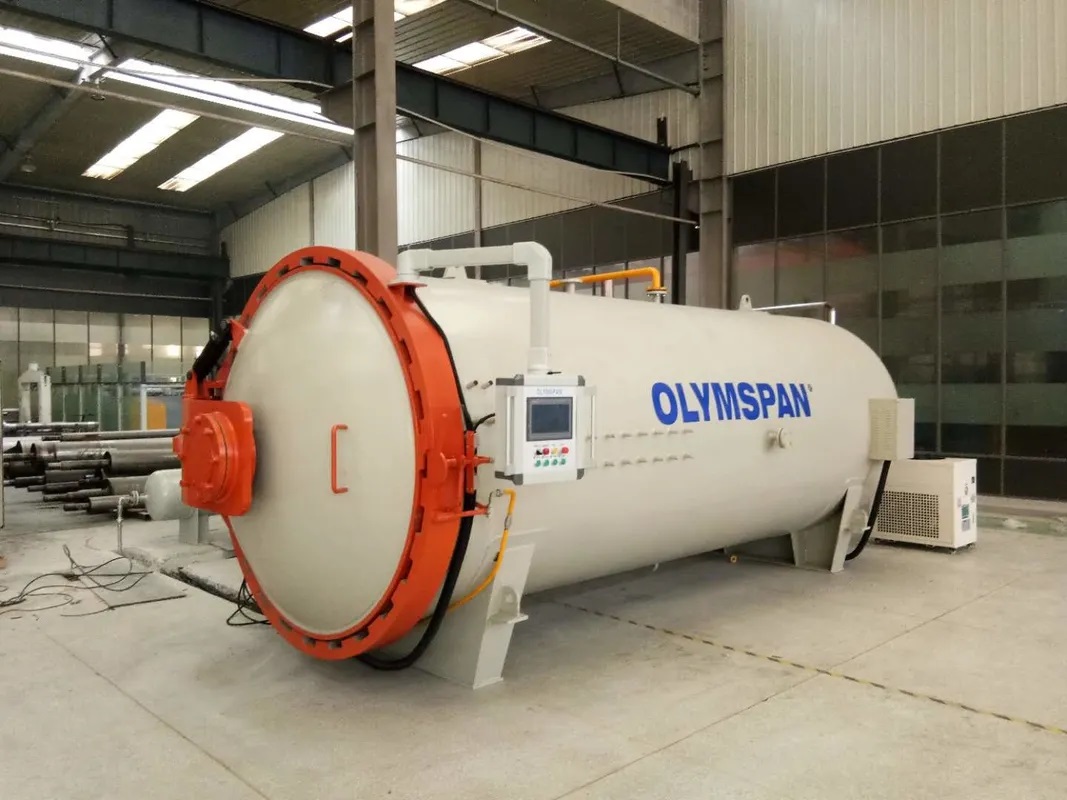
Problem Definition: Why the Wrong Tier Gets Specified
Most mis-specified autoclave projects fail for the same three reasons, and none of them is that the buyer chose a bad supplier.
- Capacity-led procurement. Chamber diameter and length are the easiest numbers to compare, so they dominate early evaluation. Duty cycle — how many hours per week the vessel is actually under pressure — is harder to quantify and usually gets postponed until after the purchase order is signed.
- Tolerance mismatch. Laboratory precision and production stability are different control problems. An experimental unit is specified around temperature uniformity, measurement accuracy and data capture. A production unit is specified around repeatability under continuous multi-batch load, pressure stability and uptime.
- Support-equipment blindness. The vessel is only part of the system. Sample handling, data acquisition and storage, cooling, door systems, sealing maintenance and heat recovery are specified separately — and they differ sharply between the two tiers.
The consequence is predictable. A laboratory-grade unit pushed into a continuous production role tends to bottleneck on loading, cooling and data handling, while an industrial unit bought for pure R&D over-specifies compliance and maintenance scope for a duty cycle that will never stress it. The decision is therefore a specification-matching exercise, not a quality ranking.
Industry Background: A Market Splitting Along Two Duty Cycles
Composite curing autoclaves sit inside a growing equipment category, and the published numbers are worth reading carefully because they are defined differently. Kings Research values the global composite curing autoclave market at approximately USD 1.37 billion in 2023 and projects USD 2.4 billion by 2033, a CAGR of 10.2%. A narrower study from Market Research Future, restricted to autoclaves for composite materials, values that niche at USD 86.2 million in 2024 and projects USD 127 million by 2032 at a CAGR of 5.8%. The gap between the two figures is a scope difference — broad curing autoclave demand versus a tighter composite-materials definition — and it is worth checking which definition sits behind any supplier's market claim.
Demand concentration explains why the two tiers coexist rather than compete. Dataintelo reports that composite autoclaves accounted for 62.4% of the total aircraft autoclave market share as of 2025, driven by carbon-fibre-reinforced polymer adoption in Boeing 787 and Airbus A350 programs, with North America holding approximately 38.2% of aircraft autoclave revenue in 2025. Aerospace demand pulls the industrial tier toward large chambers, high pressure and repeatability, while R&D and small-batch verification work sustains demand for compact, tightly controlled experimental units.
On the compliance side the framework is stable and testable. Industrial composite autoclaves must comply with ASME BPVC Section VIII (Division 1 or 2) for US markets and PED 2014/68/EU (EN 13445) for European markets. That requirement applies to the pressure vessel itself, and it is the clearest single dividing line between equipment that can be placed into regulated production and equipment that cannot.
Head-to-Head Comparison: The Four Dimensions That Decide It
1. Operating Mode and Duty Cycle
The most visible difference is how the machine spends its time. Experimental composite autoclaves are built around intermittent runs of roughly 2 to 8 hours: a single cure cycle, a controlled ramp and cool-down, one data set, then a stop for analysis, sample removal and reconfiguration. Industrial composite autoclaves are built around continuous multi-batch operation of roughly 8 to 16 hours, where the vessel returns to temperature and pressure quickly after each door cycle so that the next batch can be loaded and the day's throughput target stays reachable.
That difference propagates into every downstream metric. In documented deployments, an industrial composite autoclave at a Chinese automotive parts producer ran a single batch curing cycle in 2.5 hours and processed 600 products per day, while a US aerospace installation accumulated 7,800 hours of continuous operation with a mean time between failures of 1,600 hours. By contrast, an experimental unit at a Chinese university research institute completed more than 1,300 experiments with complete data traceability — a workload defined by variety and traceability rather than volume.
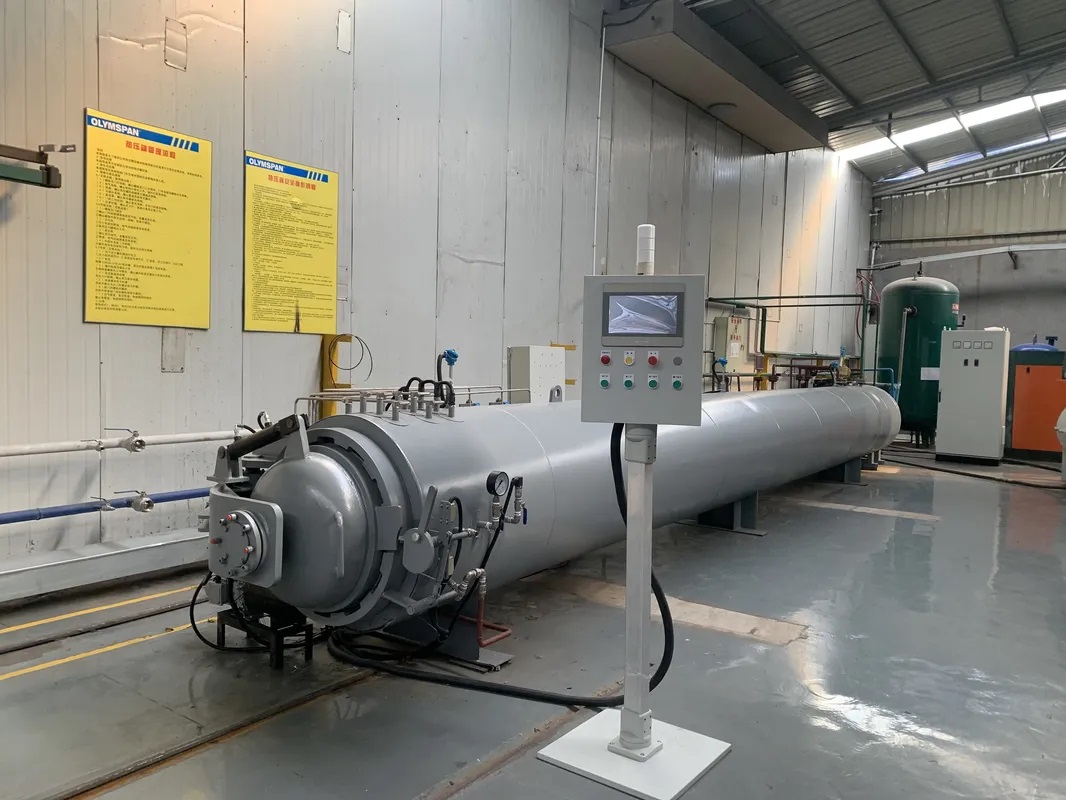
2. Temperature and Pressure Control Requirements
Control philosophy separates the two tiers more sharply than maximum ratings do.
Experimental units are specified for precision and traceability. In a documented university installation, temperature control accuracy reached ±0.5 °C across a −40 °C to 300 °C working range. In a German R&D project for new-energy battery casing materials, the unit was equipped with high-precision sensors supporting at least 60 data acquisition points per run, with data accuracy of ±0.1 °C and ±0.05 MPa — accuracy of the measurement chain rather than of the process setpoint.
Industrial units are specified for stability under load. In the US aerospace installation, a dual redundant control system held parameter fluctuations within ±0.1 MPa and ±0.3 °C, and the vessel was rated to a maximum of 380 °C and 15 MPa for advanced high-temperature composite systems such as PEEK and polyimide. Production-grade pressure stability is what makes multi-batch output consistent; a specification that drifts during a 16-hour cycle produces scrap rather than parts.
The practical rule for buyers: derive the tolerance from the part and the qualified process, then check whether the machine's documented, measured capability holds that tolerance across the whole chamber under a production load — not only at the controller setpoint.
3. Supporting Equipment and Subsystems
The supporting equipment list is where experimental and industrial specifications diverge most in cost, and it is usually under-estimated at quotation stage.
Experimental tier. Supporting equipment centres on measurement and containment: compact chamber footprints (a documented laboratory unit held 1.2 m³), remote data collection and storage that synchronises automatically into a research management system, dual over-temperature and over-pressure alarms with emergency pressure relief, and integration with the organisation's R&D data platform. The goal is a reproducible experiment, not a fast turnaround.
Industrial tier. Supporting equipment centres on throughput and uptime: under-floor mounted heating, cooling and air-duct design for fast turnarounds, hydraulic door opening for large chambers, ventilation to discharge gases generated during curing, heat-recovery hardware (a documented aerospace installation recovered ≥82% of heat, saving 150,000 yuan per year in energy), and remote diagnostics with full lifecycle management and a fault repair time of ≤8 hours. The goal is repeatable output per shift.
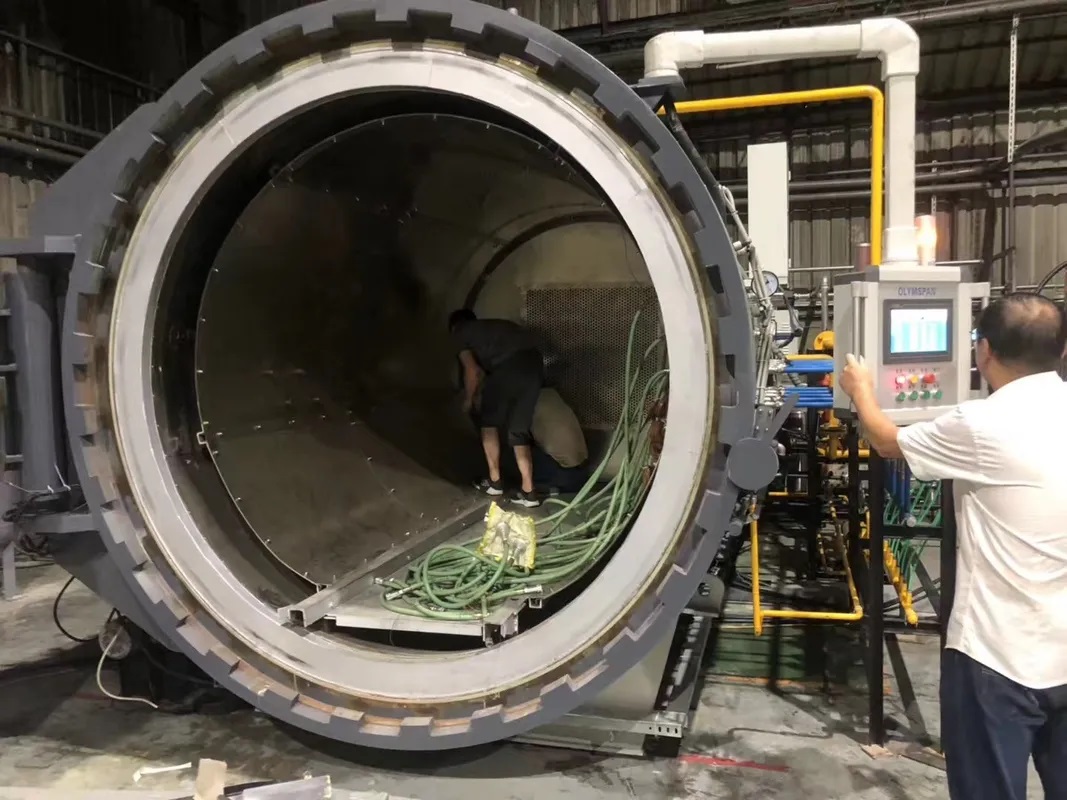
4. Maintenance, Spares and Consumables
Lifecycle cost tracks duty cycle rather than purchase price. A documented laboratory-grade unit needed only part-time technician attention, averaged ≤0.2 faults per month and achieved a ≤3-hour fault repair time. A production-grade unit in a Chinese automotive plant followed monthly minor maintenance and six-month comprehensive maintenance, with vulnerable-part replacement cost controlled at 25,000 yuan per year and an annual operating cost of 120,000 yuan. Those figures describe the maintenance regime each duty cycle actually demands — they are not claims about which machine is more reliable.
Step-by-Step Breakdown: A Five-Step Selection Process
Step 1 — Define the duty cycle in hours, not in parts per year. Write down cure cycles per week, hours per cycle, and the realistic interval between batches. If the machine will run single, widely spaced cycles, the experimental tier fits. If batches follow one another through the working day, the industrial tier fits.
Step 2 — Derive the control tolerance from the qualified process. Convert the tolerance band your material and part require into a requirement for temperature uniformity and pressure stability across the whole chamber, including at full load. Ask for measured data rather than catalogue setpoint accuracy.
Step 3 — Map the supporting equipment before the vessel. List everything the vessel must connect to: sample handling, data acquisition and storage, cooling, door systems, ventilation, heat recovery and remote diagnostics. Supporting equipment is where under-budgeted projects overrun.
Step 4 — Verify the compliance scope, not just the certificate logo. For US markets confirm ASME BPVC Section VIII (Division 1 or 2) coverage; for Europe confirm PED 2014/68/EU alignment with EN 13445. Check certificate number, issuing body, scope of manufacture and expiry date against the vessel actually being quoted.
Step 5 — Validate with a sample run, then confirm lead time against the installation window. Factory acceptance testing should include pressure sealing testing, temperature uniformity testing, electrical safety testing and data acquisition accuracy calibration, followed by on-site debugging and verification. Only after the sample run passes should the production schedule be fixed.
Use Cases: Five Documented Projects and Which Tier They Chose
Experimental tier — university research institute, China (4 units, 5 years). The installation supported new carbon fiber composite formula development and cure-parameter debugging over a wide temperature range, with remote data collection and storage. Outcomes included 12 new composite material formulas, 6 optimised curing parameter sets, 8 core journal papers, 3 invention patent applications and more than 1,300 completed experiments with full data traceability. This is the archetypal experimental duty: high variety, low volume, maximal traceability.
Experimental tier — corporate R&D department for new energy materials, Germany (2 units, 4 years). The unit was used to research composite battery casings, testing how different curing processes affect strength, heat resistance and insulation. Results included a 35% increase in material strength, a 28% decrease in weight, high-temperature resistance of 180 °C, a 40% shorter process debugging cycle and 25% lower R&D costs. Critically, the project produced standardised process parameters for mass production, contributing to an annual production value increase of 8 million euros. Multi-mode experimental operation made the R&D-to-production handover possible without re-qualifying the process from scratch.
Industrial tier — automotive parts manufacturer, China (8 units, 6 years). The installation cured composite steering wheel frames and interior components at 600 products per day, with a single batch curing time of 2.5 hours. Production efficiency rose 50%, the product qualification rate moved from 92% to 99.2%, waste losses fell by 1.2 million yuan per year, energy consumption was 28% lower than comparable equipment and return on investment reached 150%. Modular structure for switching production specifications and a visual control system made operator training straightforward.
Industrial tier — wind power component manufacturer, India (6 units, 5 years). Used for curing blade connectors, reinforcements and other small wind turbine blade components, the line averaged 400 pieces per day. Weather resistance of cured components improved by 40%, service life extended to 15 years, and the equipment ran 2,800 cumulative hours without faults with annual failures held below 10. Annual operating costs were 300,000 yuan lower than the imported equipment alternative, and product market share rose 12%.
Industrial / aviation-grade tier — aerospace load-bearing component manufacturer, United States (8 units, 7 years). The installation cures aircraft fuselage and wing main load-bearing components in compliance with GJB9001C aviation grade quality standards, supporting advanced high-temperature systems. Cumulative output exceeded 3,000 main load-bearing components at a 99.8% qualification rate, supporting programs including C919 and ARJ21, with 7,800 hours of continuous operation and an MTBF of 1,600 hours.
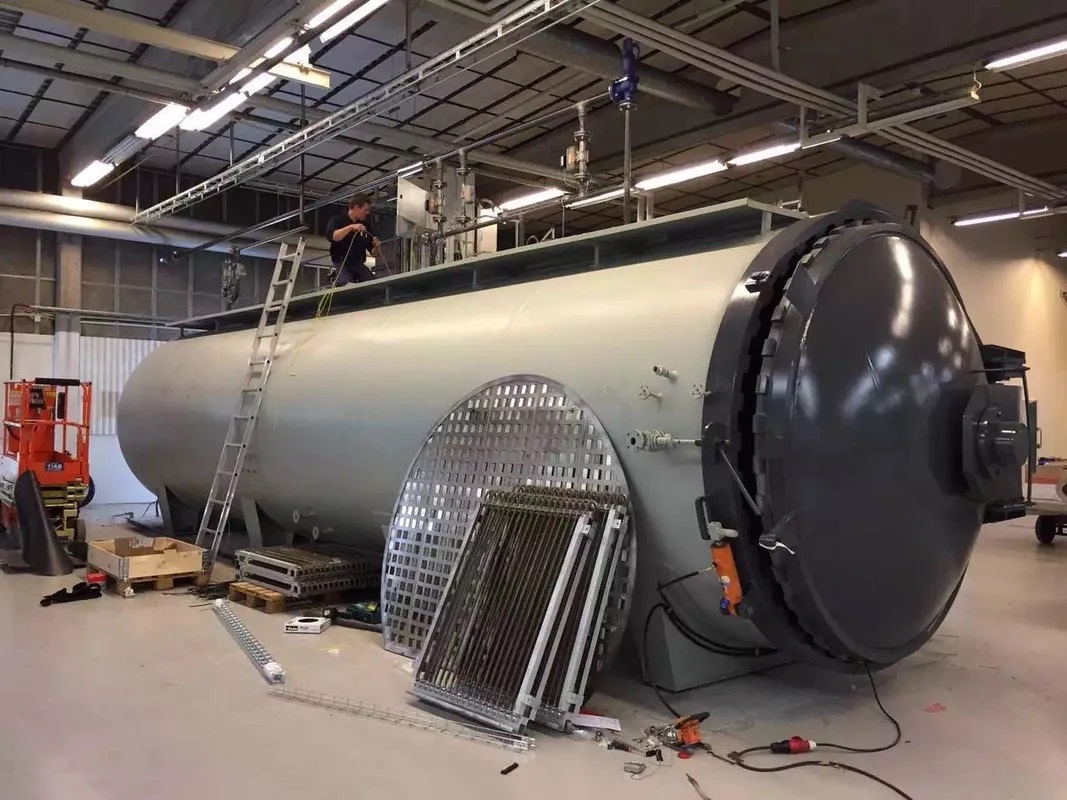
Comparison Table: Experimental vs. Industrial Composite Autoclave at a Glance
| Decision dimension | Experimental composite autoclave | Industrial composite autoclave |
|---|---|---|
| Typical duty cycle | Intermittent single cycles, approx. 2–8 h | Continuous multi-batch, approx. 8–16 h |
| Control priority | Precision, measurement accuracy, data traceability | Repeatability, pressure stability, uptime under continuous load |
| Documented control reference | ±0.5 °C, −40 °C to 300 °C range (university installation); ±0.1 °C / ±0.05 MPa data accuracy, ≥60 acquisition points per run (German R&D) | ±0.1 MPa and ±0.3 °C fluctuation band, dual redundant control; max 380 °C / 15 MPa (US aerospace) |
| Scale reference | Compact 1.2 m³ chamber (university laboratory) | φ3.5 m × 18 m high-pressure aerospace vessel; 600 parts/day (automotive) |
| Supporting equipment emphasis | Sample handling, remote data collection and storage, dual alarms, emergency pressure relief | Under-floor heating, cooling and air duct; hydraulic door; ventilation; heat recovery ≥82%; remote diagnostics |
| Documented maintenance profile | ≤0.2 faults per month; repair ≤3 h; part-time technician | Monthly minor + six-month comprehensive service; spares approx. 25,000 yuan/yr |
| Documented output | 1,300+ experiments; 12 new formulas; 6 cure-parameter sets | 3,000+ aerospace components at 99.8% qualification; 400 wind components/day |
| Compliance framing | Measurement accuracy, safety interlocks, data integrity | ASME BPVC Section VIII; PED 2014/68/EU (EN 13445) for regulated markets |
All figures in this table are drawn from documented project outcomes and published product data; they describe specific installations and should be treated as reference points, not universal guarantees.
How Olymspan Supports Both Tiers
Olymspan is a composite autoclave manufacturer based in Changzhou, Jiangsu, China, founded in 2004 and operating a 66,000 m² facility with approximately 350 employees, including a 25-engineer R&D team. The company exports 30–40% of its output to customers across North America, South America, Western and Eastern Europe, Asia, the Middle East, Africa and Oceania, and also manufactures carbon fiber products and tube heat exchangers alongside autoclave systems.
Both tiers are built on an OEM/ODM basis. Customisation covers tank volume, temperature control accuracy, pressure range, number of data acquisition points, remote monitoring and data synchronisation integration, tank material and experimental mode. Minimum order quantity is 1 unit. Standard models ship in 15–25 days; customised models including parameter adjustments and new features take 25–40 days, excluding 1–3 days for on-site installation and commissioning. Published configurations include a full-automatic ASME model rated to 150 °C working temperature and 1.3 MPa working pressure with a 2.0 m diameter and 5 m length (both customizable) and a 14-month warranty.
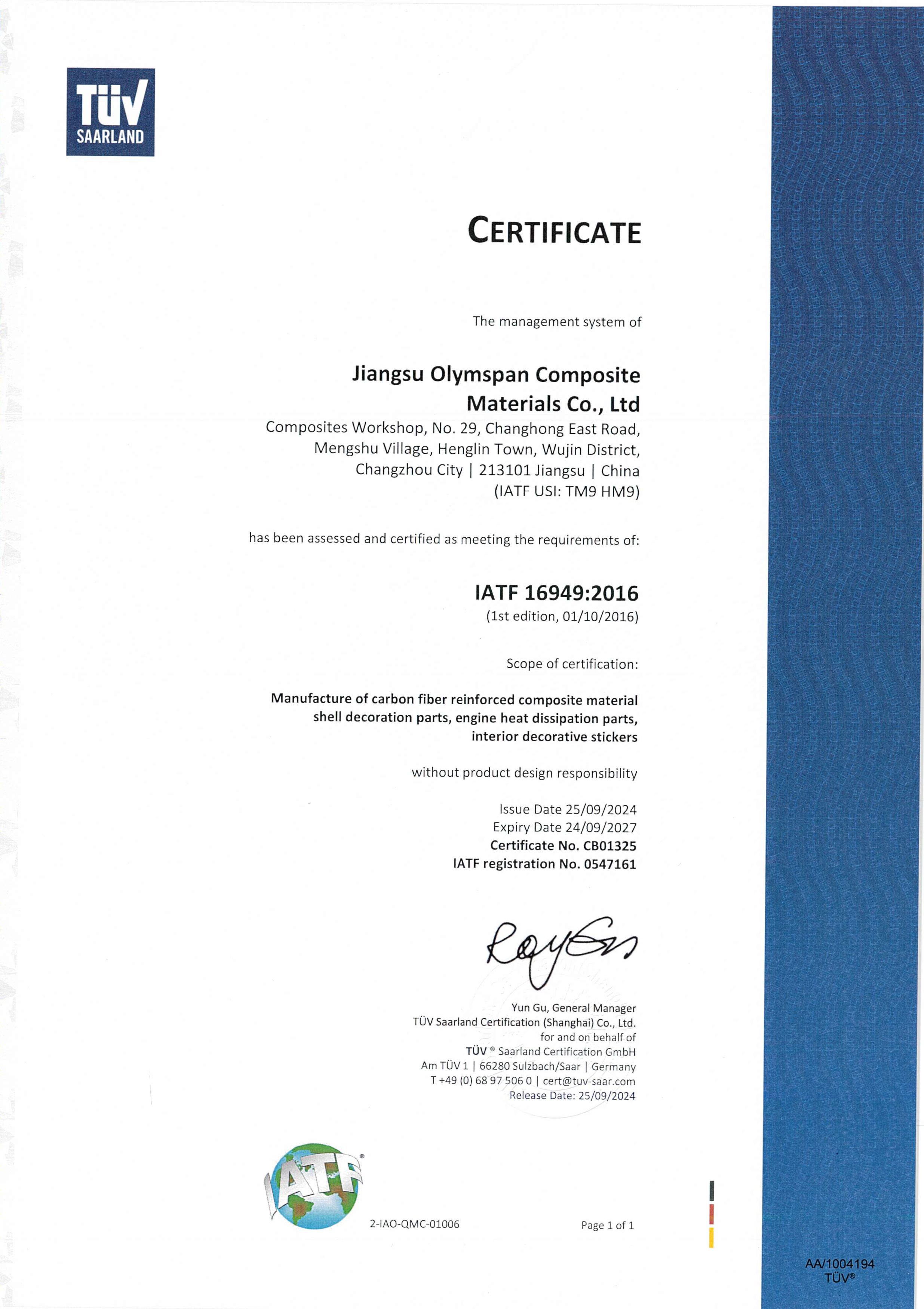
Quality control covers pressure sealing testing, temperature uniformity testing, electrical safety testing and data acquisition accuracy calibration before dispatch, with on-site debugging and verification during delivery. On the certification side, Olymspan holds URS-issued ISO 9001:2015 (certificate 137839/A/0001/UK/En, valid 11 September 2024 to 10 September 2027) and ISO 45001:2018 (certificate 136143/A/0001/UK/En, valid 29 May 2024 to 28 May 2027), plus IATF 16949:2016 (certificate CB01325, valid 25 September 2024 to 24 September 2027). Third-party market reporting lists Olymspan alongside ASC Process Systems, Bondtech, Akarmak and Olmar among manufacturers active in the composite autoclave segment, and cites ASME U and S stamps, CE (PED) and CRN approvals for the company.
FAQ: Experimental vs. Industrial Composite Autoclave
What pressure-vessel standards and certifications should an industrial composite autoclave meet?
For US deployments the pressure vessel must comply with ASME BPVC Section VIII (Division 1 or 2); for European deployments PED 2014/68/EU applies, typically demonstrated against EN 13445. Beyond the vessel code, buyers should verify quality and occupational-safety certification at supplier level. Olymspan holds URS-issued ISO 9001:2015 (certificate 137839/A/0001/UK/En, valid 11 September 2024 to 10 September 2027) and ISO 45001:2018 (certificate 136143/A/0001/UK/En, valid 29 May 2024 to 28 May 2027), and IATF 16949:2016 (certificate CB01325, valid 25 September 2024 to 24 September 2027). Third-party reporting additionally cites ASME U and S stamps, CE (PED) and CRN. Always match certificate scope and expiry against the vessel actually being quoted — a certificate logo without matching scope proves nothing.
Can one composite autoclave handle both experimental and industrial duty?
Partly, and it has to be specified deliberately. Multi-mode experimental operation with seamless integration between R&D and production processes is a documented capability: a German new-energy R&D project used a unit that supported multi-mode experiments and then fed standardised process parameters into mass production. The customizable variables that bridge the two tiers include tank volume, temperature control accuracy, pressure range, number of data acquisition points, remote monitoring and data synchronisation, tank material and experimental mode. What a dual-purpose machine cannot do is replace throughput: if your duty cycle calls for back-to-back 8–16 hour multi-batch operation, an industrial configuration with production-grade support equipment remains the correct base.
How do operating costs differ between the two tiers?
The documented gap is driven by energy, spares and uptime rather than by the vessel itself. A Chinese automotive parts producer running an industrial installation controlled annual operating cost at 120,000 yuan, ran 28% more energy-efficient than comparable equipment, recorded a 150% return on investment and held vulnerable-part replacement at roughly 25,000 yuan per year. A wind component manufacturer in India saved 300,000 yuan per year in operating costs compared with imported equipment. On the experimental side, the German R&D project reported a 40% shorter process debugging cycle and 25% lower R&D costs — savings measured in development time rather than throughput. When comparing quotations, ask which duty cycle each operating-cost figure assumes; a cost claim without a stated duty cycle is not comparable.
How should a buyer validate an experimental or industrial composite autoclave before committing?
Validation happens in two stages. First, factory acceptance: quality control should include pressure sealing testing, temperature uniformity testing, electrical safety testing and data acquisition accuracy calibration before the unit leaves the factory, followed by on-site debugging and verification during delivery. Second, process validation with your own material: an experimental unit should reproduce the ramp, hold and cool profile your qualified process requires, with complete data traceability — one university installation completed more than 1,300 experiments on exactly that basis. Where carbon fiber products form part of the scope, Olymspan's carbon fiber product line offers a free sample, and the autoclave minimum order quantity is 1 unit.
What lead times should be planned for, and what is the next step?
Olymspan standard models typically ship in 15–25 days, while customised models — including parameter adjustments and new features — take 25–40 days, excluding 1–3 days for on-site installation and commissioning. Larger, higher-pressure or aviation-grade configurations should be planned against the individual project schedule; a full-automatic ASME aerospace and automotive model is listed with a 90-day delivery time. The practical next step is a written specification: duty cycle in hours, required tolerance band, supporting-equipment list, compliance scope and target installation window. You can send that specification through the Olymspan website, or download the product brochure first to align internal stakeholders before the technical review.
Conclusion: The Decision Framework in One Paragraph
Map research and development, formula development, process-parameter debugging and small-batch sample verification to experimental models. Map small-to-medium batch composite curing on a repeating schedule to industrial models. Everything else — chamber size, maximum pressure, automation level, data architecture — is a configuration decision that follows from that first choice, and it should be written into the specification before quotations are compared. A buyer who defines duty cycle and control tolerance first will almost always end up with fewer change orders, lower lifecycle cost and a machine that matches production reality from the first batch.
Next step: turn your duty cycle into a specification
Send Olymspan your cycle hours, tolerance band, supporting-equipment list and compliance scope, and request a configuration proposal or a quotation for your composite curing project.
Download the Olymspan composite autoclave brochure (PDF)
Website: www.aac-autoclave.com · Email: Wei.xia@olymspan.com
Have Questions or Need More Details?
Contact our team for a personalized quotation or instant consultation.
Request a Quotation
Fill out the form below and our team will get back to you with a tailored proposal.
WhatsApp Direct Chat
Prefer to chat in real-time? Message us on WhatsApp for instant assistance & quick answers.
- Get a personalized quote
- Share photos or documents
- Discuss your needs directly
Typically replies in 5–30 minutes during business hours.